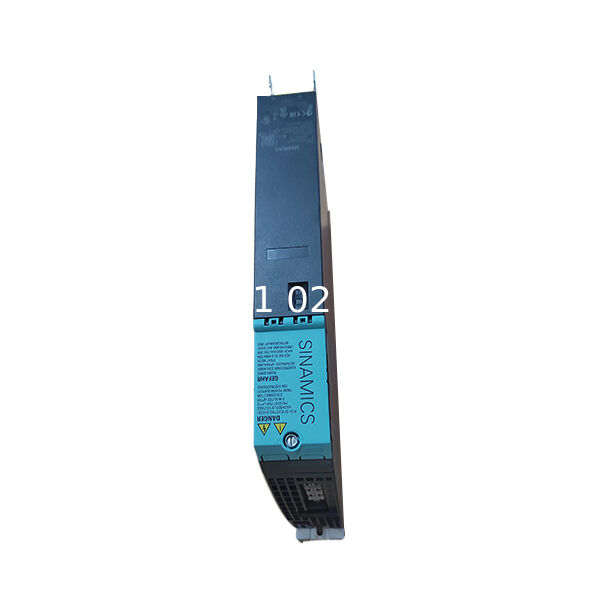
This modular drive system represents the apex of drive technology, and the Single Motor Module 6SL3120-1TE32-0AA4 stands as a specialized solution for applications demanding uncompromising power density and precision. Designed to deliver 200 A continuous current with peak capabilities up to 400 A, this module excels in high‑torque scenarios such as heavy CNC machining, industrial presses, and large‑scale material handling. Its booksize design (100 mm width) integrates regenerative energy management and SIL 2/PL d safety compliance, reducing cabinet footprint by 25% while enabling cross‑axis energy recycling for up to 15% lower operational costs.
Core Technical Specifications
The table below summarises key performance parameters:
Innovative Design & Performance Advantages
High‑Current Capability in Compact Form
The module’s 200 A continuous output supports high‑inertia loads in industrial presses or steel rolling mills, achieving torque accuracy within ±0.5% even at peak loads. Its booksize architecture enables vertical mounting alongside other power modules, minimising cabinet space by 25% compared to conventional high‑current drives. Integrated DC‑link busbar interfaces facilitate regenerative energy sharing across axes, converting braking energy into reusable power for adjacent modules.
Advanced Thermal Management
Intelligent forced‑air cooling dynamically adjusts fan speed based on real‑time heatsink temperatures, sustaining 100% output at 40°C ambient. The vertical airflow path eliminates hotspots, while field‑replaceable fans extend service life beyond 100,000 hours. Derating algorithms ensure stable operation up to 55°C in high‑density industrial environments.
Precision Control for Demanding Applications
Optimised Pulse Patterns modulate switching frequencies up to 8 kHz, reducing motor iron losses by 15% and audible noise by 20 dB. Automatic motor identification tailors control loops for compatible motors, enabling speed accuracy of ±0.01%—critical for achieving high‑quality surface finishes in precision component manufacturing.
Integrated Safety & Predictive Maintenance
Hardware‑based Safe Torque Off (STO) and Safe Stop 1 (SS1) meet SIL 2/PL d standards without external relays, triggering shutdowns within 5 μs. The embedded web server provides real‑time diagnostics for capacitor health, fan degradation, and energy consumption via standard automation software, enabling predictive maintenance intervals up to 5 years.
Targeted Industrial Applications
-
Heavy CNC Machinery – Controls spindles in gantry mills for complex metal components, leveraging 400 A peak current for uninterrupted high‑feed machining.
-
Industrial Presses & Forging – Manages high‑torque stamping cycles with servo‑mode precision (650 Hz), minimising die wear through adaptive torque ripple suppression.
-
Steel Rolling Mills – Synchronises rollers using vector control algorithms, maintaining tension within 0.5% during speed transitions up to 1,200 rpm.
-
Large‑Scale Material Handling – Powers shipyard cranes with regenerative braking, feeding energy back to DC links during container lowering cycles.
-
Energy‑Intensive Processes – Optimises centrifugal compressors in industrial plants, reducing grid dependency by 12% through cross‑axis energy reuse.
Seamless Integration with Industrial Automation Ecosystems
Plug‑and‑Play Drive‑Bus Connectivity
Pre‑installed drive‑bus cables enable single‑cable connections to compatible motors and encoders (SSI/TTL/HTL), reducing commissioning time by 40%. Supports cable lengths up to 300 m for flexible machine layouts.
Unified Engineering Software Compatibility
Preconfigured function blocks automate safety parameterisation and motion tuning. Digital twin simulation via virtual commissioning tools validates high‑current motion profiles offline, eliminating physical debugging risks.
Scalability for Multi‑Drive Systems
Cascades with up to six axes via shared DC links, ideal for modular production lines. Compatible with standard control units for real‑time industrial Ethernet synchronisation with ≤±1 μs jitter.
Total Cost of Ownership (TCO) Advantages
-
Energy Savings – Regenerative feedback cuts net consumption by 12–15%, aligning with IEC 61800‑9‑2 sustainability standards.
-
Maintenance Reduction – Predictive algorithms monitor capacitor aging, extending service intervals to 5 years and reducing unplanned downtime by 30%.
-
Hardware Optimisation – Integrated safety eliminates external relays, while shared cooling lowers auxiliary component costs.
-
Global Compliance – Certifications include CE, UL, cULus, RoHS, and IEC 61800‑3 for EMI/EMC resilience.
Conclusion: Powering Industrial Transformation
This high‑current single motor module (6SL3120-1TE32-0AA4) redefines high‑current motion control by merging 200 A power density, adaptive intelligence, and sustainable energy management. Its ability to deliver servo‑grade precision in heavy industrial applications—while reducing footprint, energy costs, and lifecycle maintenance—makes it indispensable for OEMs advancing Industry 4.0 automation. As manufacturing evolves toward decentralised intelligence, this module remains engineered to meet future demands for resilience, connectivity, and efficiency.