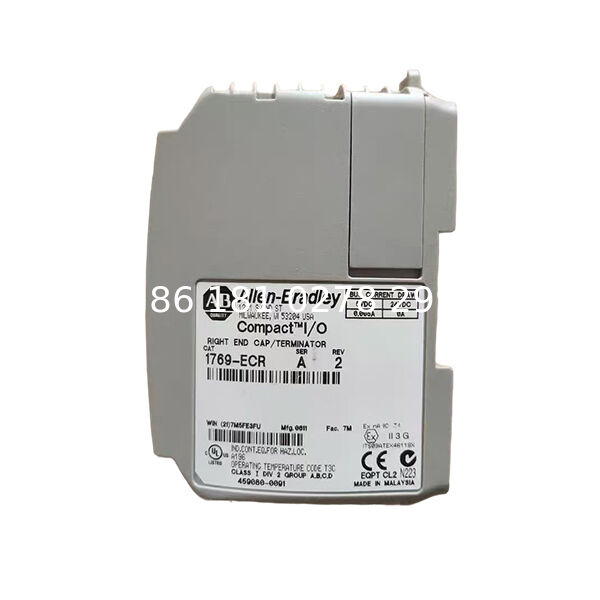
The 1769-ECR is a right end cap module designed for 1769 Compact I/O expansion assemblies.
Unlike standard input, output or communication modules, this component does not provide signal processing functions. Its purpose is to complete the right side of the I/O assembly by terminating the expansion bus and providing the final mechanical connection point of the module group.
Installed at the end of a 1769 I/O configuration, the 1769-ECR helps maintain proper system structure when multiple expansion modules are connected together. It is an essential accessory for completing a valid local I/O assembly.
The compact design allows installation in space-limited control panels and supports typical DIN rail mounted automation systems.
Key Features
- Right-side expansion bus termination
- Designed for 1769 I/O assemblies
- Completes modular I/O structure
- Compact DIN rail installation
- No signal processing required
- Supports local expansion configurations
- Essential for proper module assembly
Typical Applications
- Compact machine controllers
- Distributed machine I/O panels
- Equipment retrofit projects
- Industrial control cabinets
- Modular automation systems
Right End Cap Function
The main purpose of 1769-ECR is to close the right side of a 1769 I/O module assembly.
It provides:
- Bus termination
- Mechanical end closure
- Proper module arrangement
- Protection of the final expansion connection
Without the correct end cap, the I/O assembly may not meet the required hardware configuration.
Passive System Component
Unlike analog or digital I/O modules, the 1769-ECR:
- Does not read input signals
- Does not control output devices
- Does not provide communication conversion
- Does not contain configurable channels
Its role is structural and electrical termination within the I/O assembly.
1769-ECR vs 1769-ECL
1769-ECR
Right end cap
Installed on the right side
1769-ECL
Left end cap
Installed on the left side
The two components have different installation positions and are not interchangeable.
1769-ECR vs I/O Modules
1769-ECR
System accessory
Bus termination function
1769 Digital/Analog Modules
Signal processing modules
Provide input, output or communication functions
The 1769-ECR should always be selected according to the physical I/O assembly requirement rather than signal requirements.
Installation Position
The 1769-ECR must be installed:
- At the far right side of the 1769 module group
- After the final expansion module
- According to the system assembly instructions
Incorrect placement may prevent proper I/O system operation.
Replacement Considerations
Before replacement, confirm:
- Exact end cap direction
- Number of installed modules
- Expansion assembly structure
- Existing left and right end components
- Mechanical connection condition
A similar-looking end component may not provide the same termination function.
Why the End Cap Is Required
The right end cap provides:
- Completion of the expansion bus
- Proper physical module alignment
- Protection of the final connection point
- Correct system assembly
It is a small component but necessary for a complete modular I/O installation.
Installation Notes
- Disconnect system power before installation
- Place the module group correctly on DIN rail
- Install the final I/O module first
- Attach the right end cap firmly
- Verify module locking position
- Check controller communication after power-up
- Confirm all modules are recognized
FAQ
Q1: What is the function of 1769-ECR?
A1: It is a right end cap used to terminate the expansion bus of a 1769 I/O assembly.
Q2: Is 1769-ECR an input or output module?
A2: No. It is a passive system accessory, not a signal processing module.
Q3: Where is 1769-ECR installed?
A3: It is installed on the right side of the 1769 I/O module group.
Q4: Can it replace 1769-ECL?
A4: No. 1769-ECL is a left end cap and has a different installation position.
Q5: Is the end cap required for every configuration?
A5: It is required when completing the corresponding 1769 I/O assembly structure.
Q6: Does it require software configuration?
A6: No. It is a hardware termination component.
Q7: Does it increase I/O points?
A7: No. It does not add input or output channels.
Q8: Why is it important?
A8: It completes the physical and electrical structure of the modular I/O expansion system.

 Your message must be between 20-3,000 characters!