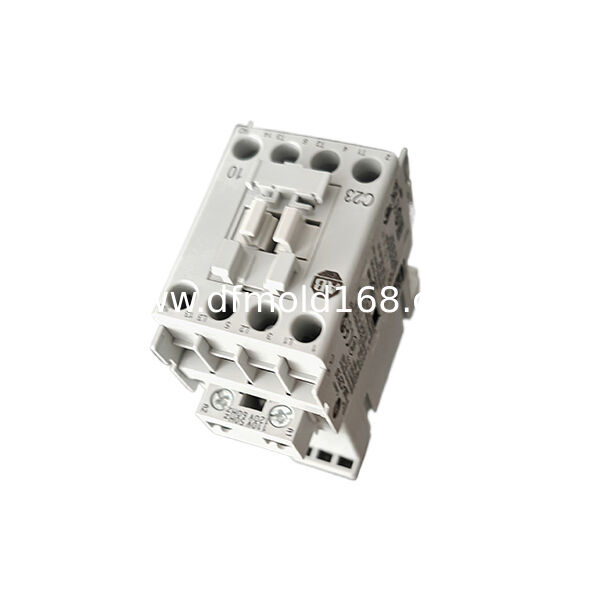
The 100-C23ED400 is a 23 A four-pole IEC contactor designed for industrial switching applications that require a 110 to 125 V DC electronic control coil.
Its most important difference is the combination of four normally open main poles and a wide-range DC electronic coil. All four poles operate together, making the contactor suitable for motor circuits and other applications where an additional switched conductor is required.
The electronic coil is designed for a 110 to 125 V DC control supply. This value refers to the contactor coil circuit and must not be confused with the voltage of the switched main load.
With screw terminals, line-side coil termination and DIN-rail or panel mounting capability, the unit is suited to industrial control panels, motor starters and replacement of an existing contactor with the same coil and pole configuration.
Key Features
- 23 A IEC contactor
- Four normally open main poles
- 110–125 V DC electronic coil
- Approximately 11 kW motor rating at 415 V AC-3
- Screw-terminal connections
- Line-side coil termination
- DIN-rail or panel mounting
- Suitable for four-pole switching circuits
Typical Applications
- Three-phase motors with switched neutral
- Industrial motor starters
- Heating load switching
- Pump and fan panels
- Existing contactor replacement
Four Normally Open Main Poles
The 100-C23ED400 provides four normally open power poles.
This configuration can be used where the circuit requires simultaneous switching of:
- Three motor phases and one additional conductor
- Three-phase load and neutral
- Multiple coordinated power circuits
- Four independent conductors controlled together
It is different from common three-pole contactors and should be selected only when the fourth power pole is required.
110–125 V DC Electronic Coil
The ED400 configuration uses an electronic coil designed for a 110 to 125 V DC control supply.
The electronic coil provides a defined control-voltage range for applications such as:
- DC control panels
- Battery-supported control systems
- Industrial control power supplies
- Retrofit systems using 110 or 125 V DC control voltage
The coil voltage is not the same as the main contact load voltage.
23A Switching Capacity
Rated Operational Current
23 A
Motor Rating at 415 V AC-3
Approximately 11 kW
Actual load suitability depends on:
- Utilization category
- Main circuit voltage
- Motor power
- Starting method
- Switching frequency
- Ambient temperature
- Coordination with overload protection
The contactor must not be selected using the 23 A value alone.
AC-1 and AC-3 Applications
Contactor ratings vary according to the connected load.
AC-1 applications generally include:
- Resistive heating loads
- Non-inductive or slightly inductive loads
AC-3 applications generally include:
- Squirrel-cage motors
- Starting and stopping a running motor
- Pumps
- Fans
- Conveyors
The correct operational current must be selected using the intended utilization category.
Electronic Coil Advantage
Compared with a conventional fixed-voltage coil, the electronic coil supports its specified voltage band and provides controlled coil operation.
This can help with:
- Control-voltage tolerance
- Reliable contactor pickup
- Stable coil holding
- Replacement in 110–125 V DC systems
The actual control supply must remain within the documented range.
Line-Side Coil Termination
This configuration places the control-coil termination on the line side of the contactor.
The terminal arrangement should be checked when replacing an existing unit because it affects:
- Panel wiring route
- Control-wire length
- Access during maintenance
- Compatibility with existing assemblies
A contactor with the same current but a different terminal arrangement may require rewiring.
No Built-In Auxiliary Contact Configuration
The base 100-C23ED400 configuration is listed without an integrated auxiliary-contact arrangement.
Where auxiliary status signals are required, confirm whether compatible add-on contacts are included separately.
Auxiliary contacts may be used for:
- Electrical interlocking
- Contactor status feedback
- Seal-in circuits
- Alarm circuits
- Controller input signals
Do not assume auxiliary contacts are included unless stated in the quotation.
100-C23ED400 vs Three-Pole Contactor
100-C23ED400
Four normally open power poles
Suitable for switching an additional conductor
110–125 V DC electronic coil
Typical Three-Pole Contactor
Three normally open power poles
Primarily switches three-phase conductors
No fourth main power pole
The four-pole construction is the main mechanical and electrical difference.
100-C23ED400 vs 100-C23ED10
100-C23ED400
Four normally open main poles
No base auxiliary contact configuration
100-C23ED10
Different main or auxiliary contact arrangement
Must be checked against the exact circuit requirement
Similar model prefixes do not guarantee identical contact configurations.
100-C23ED400 vs AC-Coil Version
100-C23ED400
110–125 V DC electronic coil
AC-Coil Variant
Designed for a specified AC control voltage and frequency
They are not directly interchangeable unless the control supply and wiring match the replacement coil specification.
Motor Starter Coordination
The contactor itself does not provide motor overload protection.
A complete motor starter normally requires:
- Short-circuit protection
- Contactor
- Correctly sized overload relay
- Control circuit protection
- Emergency-stop arrangement where required
All components must be coordinated with the motor current and applicable electrical standards.
Replacement Checks
Before ordering, verify:
- Complete model number
- Four-pole requirement
- Main contact arrangement
- 23 A current class
- 110–125 V DC coil supply
- Coil terminal location
- Existing overload relay
- Auxiliary-contact requirements
- Mechanical mounting dimensions
- Wiring terminal arrangement
Matching only the frame size or coil voltage is not sufficient.
Installation Notes
- Isolate the main and control power supplies
- Confirm the control circuit is 110–125 V DC
- Verify the need for four normally open poles
- Check conductor size and terminal torque
- Coordinate the contactor with overload protection
- Install suitable short-circuit protection
- Confirm coil polarity requirements where applicable
- Test pickup and release operation
- Verify all four poles open and close correctly
- Test the controlled load before production
FAQ
Q1: What is the rated current of 100-C23ED400?
A1: It is a 23 A IEC contactor, subject to the applicable load category and operating conditions.
Q2: How many main poles does it have?
A2: It has four normally open main poles.
Q3: What is the coil voltage?
A3: It uses a 110 to 125 V DC electronic control coil.
Q4: Does 110–125 V DC refer to the main load voltage?
A4: No. It refers to the control-coil supply voltage.
Q5: What motor power can it switch?
A5: The documented motor rating is approximately 11 kW at 415 V under the applicable AC-3 conditions.
Q6: Does it include overload protection?
A6: No. A compatible overload relay and short-circuit protection must be selected separately.
Q7: Does it include auxiliary contacts?
A7: The base ED400 configuration is listed without an auxiliary-contact arrangement. Any add-on contact blocks should be confirmed separately.
Q8: What distinguishes it from a standard three-pole contactor?
A8: It provides a fourth normally open power pole for circuits requiring simultaneous switching of an additional conductor.

 Your message must be between 20-3,000 characters!