Highlight:
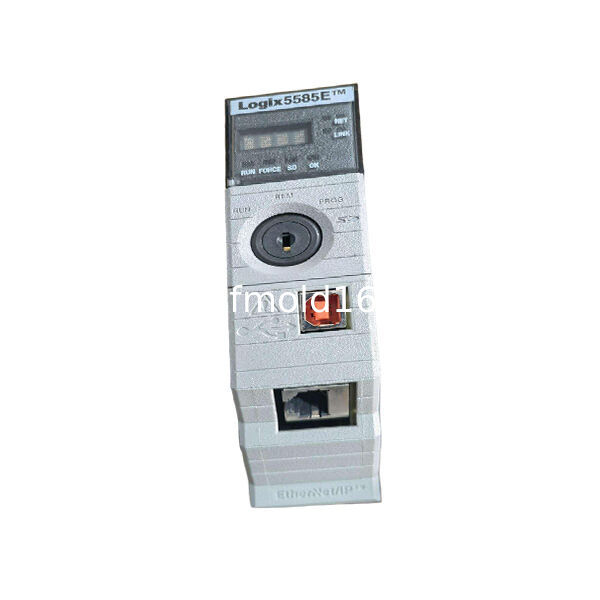
1756-L81E 5580 Controller 3MB Memory 1Gb Ethernet 100 EtherNet/IP Nodes
The 1756-L81E is a 5580 chassis-mounted programmable controller designed for distributed industrial systems requiring high-speed Ethernet communication, coordinated I/O control and scalable machine or process architecture.
Its defining feature is the combination of 3 MB user memory with an embedded 1 Gigabit Ethernet port supporting as many as 100 configured EtherNet/IP device nodes. This allows the controller to coordinate remote I/O, drives, operator interfaces and other compatible network devices without relying exclusively on a separate Ethernet communication module.
The controller also provides a USB programming port, Secure Digital nonvolatile storage and a four-character alphanumeric display for local status and diagnostic information.
Unlike compact controllers with built-in I/O, the 1756-L81E installs in a modular chassis and works with separately selected local or distributed I/O modules.
Key Features
- 3 MB user memory
- Embedded 1 Gigabit Ethernet port
- Up to 100 EtherNet/IP device nodes
- USB local programming port
- Secure Digital nonvolatile storage
- Four-character status display
- Integrated motion capability
- Chassis-based modular architecture
Typical Applications
- Large packaging lines
- Material-handling systems
- Multi-drive production machines
- Distributed process equipment
- Plant modernization projects
Embedded 1Gb Ethernet Port
The embedded Ethernet port is one of the primary differences between the 1756-L81E and earlier chassis controllers that depend on separate communication modules.
The port supports:
- EtherNet/IP controller communication
- Distributed I/O connections
- Drive and motion-device integration
- Operator-interface communication
- Controller programming and diagnostics
- Networked machine coordination
Actual network performance depends on device connections, requested packet intervals, message traffic and application loading.
100 EtherNet/IP Node Capacity
The controller supports up to 100 EtherNet/IP nodes under the applicable software and firmware configuration.
A node is typically a device added directly to the project I/O configuration, such as:
- Remote I/O adapter
- Variable-frequency drive
- Servo drive
- Communication adapter
- Networked instrumentation device
The node limit should not be confused with the total number of Ethernet devices physically connected to the plant network.
3MB User Memory
The 1756-L81E provides 3 MB of user memory for:
- Control routines
- Tags and production data
- I/O configurations
- Motion instructions
- Communication settings
- Equipment sequencing
It is the entry memory size within the standard 5580 L8E controller range.
Applications requiring larger programs or extensive data storage may require an L82E, L83E, L84E or L85E controller.
Large I/O Architecture
The controller platform supports large distributed I/O configurations.
Maximum Digital I/O
128,000 Points
Maximum Analog I/O
4,000 Points
These are controller-platform limits rather than quantities built directly into the processor.
Actual usable capacity depends on:
- Installed communication modules
- Network topology
- Chassis arrangement
- Connection resources
- Controller memory
- Application scan requirements
Chassis-Based Modular Design
The 1756-L81E does not contain embedded field I/O.
It is installed in a compatible 1756 chassis together with separately selected components such as:
- Power supply
- Digital I/O modules
- Analog I/O modules
- Communication modules
- Motion modules
- Specialty modules
This modular design allows the control architecture to be expanded according to the machine or process requirements.
Integrated Motion Capability
The controller supports integrated motion over EtherNet/IP when used with compatible motion devices and correctly configured engineering software.
This allows:
- Coordinated servo-axis control
- Networked motion commands
- Machine sequencing
- Electronic gearing
- Position and speed coordination
Motion capacity depends on controller resources, update rates and the complete system configuration.
Controller Redundancy
The 1756-L81E can be used in a compatible controller-redundancy architecture.
Redundancy applications require:
- Matching controller hardware
- Compatible firmware revisions
- Redundancy modules
- Matched chassis configuration
- Correct engineering software
- Approved communication architecture
The embedded Ethernet port and integrated motion functions can be restricted when the controller is configured for redundancy.
USB Programming Port
The local USB port is intended for commissioning, programming and maintenance access.
It can be used for:
- Project download and upload
- Controller diagnostics
- Firmware-related service
- Local configuration
- Troubleshooting
The USB port is a temporary local programming connection and is not intended as a permanent industrial network interface.
Secure Digital Storage
The controller supports Secure Digital nonvolatile memory for supported storage functions, including:
- Controller project backup
- Application image storage
- Firmware operations
- Recovery procedures
- Load and store functions
The installed memory-card capacity and stored project should be checked before replacing an existing controller.
Four-Character Status Display
The front display provides local controller and network information.
It can assist maintenance personnel with:
- Controller operating status
- Network address information
- Startup conditions
- Fault identification
- Diagnostic messages
The display provides faster local troubleshooting than controllers that rely only on basic status LEDs.
1756-L81E vs 1756-L82E
1756-L81E
3 MB user memory
Up to 100 EtherNet/IP nodes
Entry capacity in the L8E range
1756-L82E
5 MB user memory
Up to 175 EtherNet/IP nodes
Higher program and network capacity
The L82E is more appropriate when the application exceeds the L81E memory or node limits.
1756-L81E vs 1756-L81ES
1756-L81E
Standard industrial controller
3 MB user memory
No integrated safety memory
1756-L81ES
Safety controller
3 MB standard memory
Additional safety memory
Requires compatible safety architecture
The standard L81E should not be advertised as a functional-safety controller.
1756-L81E vs 1756-L81E-NSE
1756-L81E
Standard energy-storage configuration
Secure Digital storage support
1756-L81E-NSE
No Stored Energy version
Designed for applications with specific stored-energy restrictions
Different hardware configuration
The NSE reference is not interchangeable solely because it provides the same 3 MB memory and network-node capacity.
1756-L81E vs Earlier 5570 Controllers
1756-L81E
Embedded 1Gb EtherNet/IP port
5580 processing platform
100 EtherNet/IP node capacity
Four-character display
Earlier 5570 Controllers
Different processor platform
Ethernet communication often requires a separate module
Different memory, firmware and performance characteristics
Migration requires review of firmware, chassis modules, communication architecture and application compatibility.
Network Planning
Before selecting the controller, verify:
- Number of EtherNet/IP I/O nodes
- Required drive and motion connections
- HMI and message traffic
- Requested packet intervals
- Local and remote chassis quantity
- Controller memory usage
- Redundancy requirements
- Safety requirements
- Software and firmware compatibility
Selecting only by the 3 MB memory value may overlook network and application requirements.
Replacement Compatibility
Before replacing an existing controller, record:
- Complete catalog number
- Hardware series
- Firmware revision
- Controller project version
- Ethernet address
- Chassis slot location
- Communication modules
- Motion configuration
- SD-card contents
- Redundancy configuration
- Produced and consumed tags
- Retentive application data
A replacement processor may require firmware alignment before the original project can be downloaded.
Installation Notes
- Back up the active project and SD card
- Record the current firmware revision
- Record Ethernet and network settings
- Place equipment in a safe state
- Disconnect chassis power
- Confirm the correct chassis slot
- Verify module keying and compatibility
- Restore the controller project
- Confirm all network connections
- Test I/O and motion functions
- Verify redundancy status where applicable
- Validate production operation before release
FAQ
Q1: How much user memory does 1756-L81E provide?
A1: It provides 3 MB of user memory.
Q2: Does it include an Ethernet port?
A2: Yes. It includes one embedded 1 Gigabit EtherNet/IP port.
Q3: How many EtherNet/IP nodes are supported?
A3: It supports up to 100 configured EtherNet/IP device nodes under the applicable system configuration.
Q4: Does the controller include field I/O?
A4: No. It is a chassis-mounted controller used with separately selected local or distributed I/O modules.
Q5: Does it support integrated motion?
A5: Yes. It supports integrated motion over EtherNet/IP with compatible drives and system configuration.
Q6: Is 1756-L81E a safety controller?
A6: No. The safety-controller version uses a different catalog reference, such as 1756-L81ES.
Q7: What is the difference from 1756-L82E?
A7: L81E has 3 MB memory and supports up to 100 EtherNet/IP nodes, while L82E has 5 MB and supports up to 175 nodes.
Q8: Does it support controller redundancy?
A8: Yes, when used with compatible redundancy hardware, firmware and chassis configuration.

 Your message must be between 20-3,000 characters!