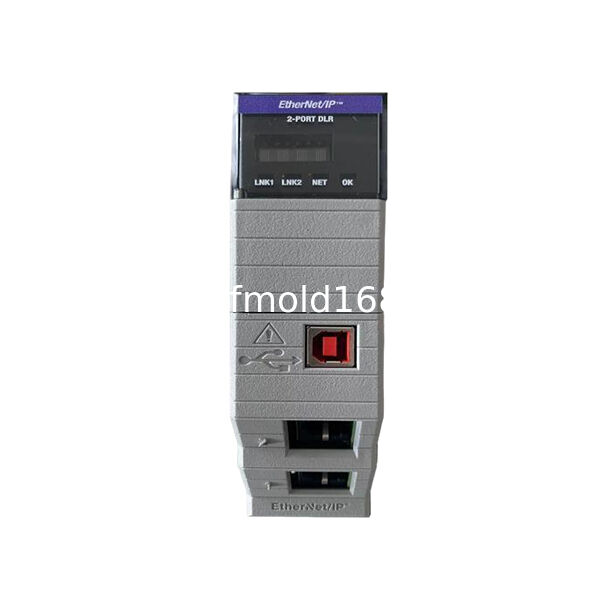
The 1756-EN2TR is a dual-port EtherNet/IP communication module designed to connect a 1756 chassis with industrial Ethernet controllers, distributed I/O, drives, operator interfaces and other compatible network devices.
Its defining difference is the pair of embedded RJ45 ports. Unlike a single-port communication module, the 1756-EN2TR can participate directly in a Device Level Ring or linear network without requiring a separate Ethernet switch at each chassis location.
The module operates at 10 or 100 Mbps and supports up to 128 TCP connections and 256 CIP connections. It also provides a temporary USB service port for local configuration, programming and diagnostics.
This module does not execute the machine control program and does not provide field I/O points. Its function is to create the Ethernet-to-chassis-backplane communication path.
Key Features
- Two 10/100 Mbps RJ45 ports
- Device Level Ring network support
- Linear and star topology compatibility
- Up to 128 TCP connections
- Up to 256 CIP connections
- Chassis-to-EtherNet/IP communication
- Temporary USB service port
- Single-slot chassis installation
Typical Applications
- Remote I/O chassis communication
- Multi-drive machine networks
- Redundant Ethernet ring systems
- Distributed production lines
- Existing 1756 system expansion
Dual RJ45 Ethernet Ports
The two integrated Ethernet ports allow the module to connect directly between network devices.
This supports:
- Device Level Ring architecture
- Linear daisy-chain connections
- Conventional switched star networks
- Two-direction network cabling
- Reduced external-switch requirements
Both ports belong to the same network interface and normally use one module IP address.
They are not two independently routed Ethernet networks.
Device Level Ring Support
Device Level Ring provides a resilient industrial Ethernet topology.
In a correctly configured ring:
- Each device connects to two neighboring devices
- Communication can continue through the alternate path after one cable interruption
- Ring status can be monitored by the network supervisor
- Network recovery is handled automatically
DLR improves cable-path availability, but it does not make every controller, power supply or chassis component redundant.
Linear Network Capability
The dual-port design can also be used in a linear topology.
A linear network can reduce:
- Switch quantity
- Panel space
- Ethernet cable routing
- Installation complexity
However, a cable or device failure in the middle of a linear chain can disconnect downstream devices.
DLR should be evaluated when network-path resilience is required.
10/100 Mbps Communication
The module supports automatic 10/100 Mbps Ethernet communication.
It is suitable for:
- Cyclic I/O data
- Controller messaging
- Drive communication
- Operator-interface data
- Programming and diagnostics
It is not a 1 Gigabit Ethernet module.
Applications requiring higher bandwidth or newer cybersecurity functions should be evaluated against later communication-module generations.
Connection Capacity
Maximum TCP Connections
128
Maximum CIP Connections
256
The CIP connection capacity may be used by:
- Distributed I/O adapters
- Produced and consumed data
- Controller messaging
- Drives
- Operator interfaces
- Other compatible EtherNet/IP devices
The number of physical devices on a network is not always the same as the number of active CIP or TCP connections.
System design should consider both device count and connection usage.
Ethernet-to-Backplane Communication
The module transfers information between the Ethernet network and the 1756 chassis backplane.
This enables devices on the network to communicate with:
- Chassis controllers
- Local digital I/O
- Local analog I/O
- Specialty modules
- Other communication modules
The module itself does not contain user-program execution memory.
Temporary USB Service Port
The USB port is intended for temporary local service.
Typical uses include:
- Initial configuration
- Module diagnostics
- Local programming access
- Firmware maintenance
- Troubleshooting
It should not be used as a permanent industrial communication connection.
The USB port should also not be used in hazardous locations.
1756-EN2TR vs 1756-EN2T
1756-EN2TR
Two RJ45 Ethernet ports
Supports Device Level Ring
Supports linear topology
Suitable for ring or daisy-chain networks
1756-EN2T
One RJ45 Ethernet port
Typically connects through an external Ethernet switch
Does not provide direct two-port DLR connectivity
The second port and DLR capability are the primary differences.
1756-EN2TR vs 1756-EN3TR
1756-EN2TR
Dual 10/100 Mbps ports
Up to 256 CIP connections
Standard network capacity
1756-EN3TR
Dual 10/100 Mbps ports
Higher communication capacity
Better suited to larger connection loads
The correct module should be selected according to actual connection and traffic requirements.
1756-EN2TR vs 1756-EN4TR
1756-EN2TR
10/100 Mbps Ethernet
Earlier dual-port platform
256 CIP connections
1756-EN4TR
1 Gigabit Ethernet capability
Higher connection and packet capacity
Supports newer security and network functions
The EN4TR is intended for applications requiring greater bandwidth, scalability or cybersecurity capability.
1756-EN2TR vs 1756-EN2TRXT
1756-EN2TR
Standard industrial environmental range
Standard 1756 chassis installation
1756-EN2TRXT
Extended-environment version
Designed for compatible extreme-temperature system components
The XT version should be selected only as part of a compatible extended-environment architecture.
Open-Style Chassis Module
The 1756-EN2TR is an open-style module.
It must be installed:
- Inside a compatible chassis
- In a suitable industrial enclosure
- Away from conductive contamination
- With adequate ventilation
- Within the documented environmental range
It is not a standalone sealed Ethernet gateway.
Network Planning
Before installation, confirm:
- Required topology
- Number of Ethernet devices
- Estimated TCP connections
- Estimated CIP connections
- Requested packet intervals
- Multicast and unicast traffic
- Ring-supervisor configuration
- Controller and firmware compatibility
- Managed-switch configuration
- IP address plan
A network can exceed the practical performance limit before reaching the theoretical connection limit if traffic is configured inefficiently.
Replacement Compatibility
Before replacing an existing module, record:
- Complete catalog number
- Hardware series
- Firmware revision
- Existing IP address
- Subnet mask
- Gateway address
- Chassis slot
- Ring-supervisor settings
- Network topology
- Controller project configuration
- Produced and consumed connections
A replacement module may require firmware alignment and network reconfiguration before communication resumes.
Installation Notes
- Back up the active controller project
- Record all Ethernet settings
- Place the machine in a safe state
- Disconnect chassis power
- Install the module in the correct slot
- Connect suitable Ethernet cables
- Avoid connecting a ring incorrectly
- Assign the correct IP configuration
- Verify module and link indicators
- Confirm all I/O connections
- Test ring recovery where applicable
- Validate machine communication before production
FAQ
Q1: How many Ethernet ports does 1756-EN2TR provide?
A1: It provides two copper RJ45 Ethernet ports.
Q2: What communication speed does it support?
A2: It supports 10 and 100 Mbps Ethernet communication.
Q3: Does it support Device Level Ring?
A3: Yes. The dual-port design supports Device Level Ring topology.
Q4: How many TCP connections are supported?
A4: It supports up to 128 TCP connections.
Q5: How many CIP connections are supported?
A5: It supports up to 256 CIP connections.
Q6: Does it run the machine-control program?
A6: No. It is a communication module that links the Ethernet network to the chassis backplane.
Q7: What distinguishes it from 1756-EN2T?
A7: EN2TR has two Ethernet ports and supports direct DLR or linear connections, while EN2T is a single-port module.
Q8: Is the USB port intended for permanent communication?
A8: No. The USB port is intended only for temporary local programming and maintenance.

 Your message must be between 20-3,000 characters!