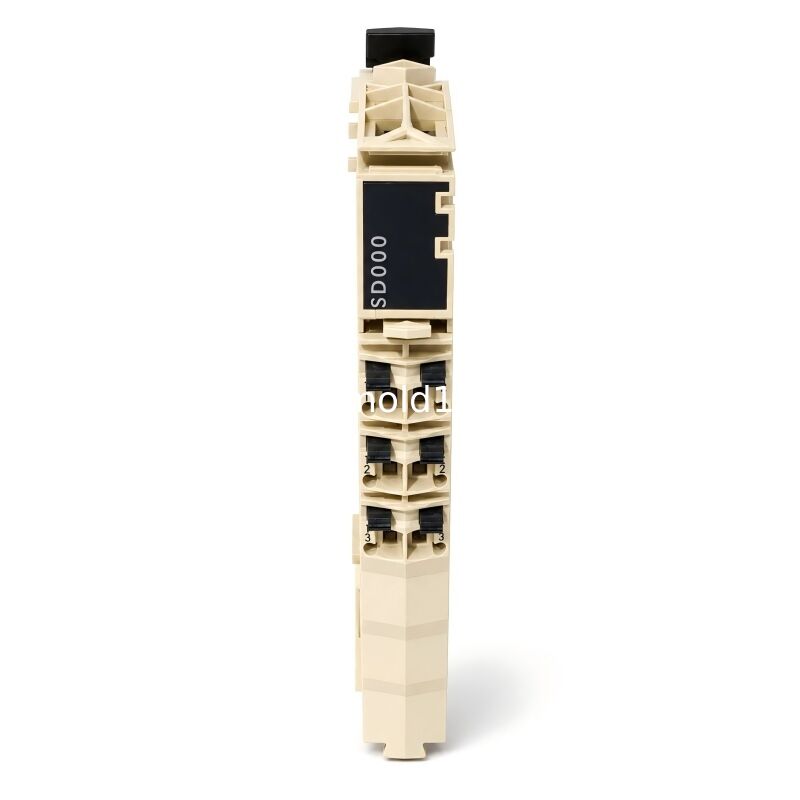
The TM5SD000 is a non-functional Modicon TM5 dummy module used to reserve a standard slice position for future I/O expansion.
It does not provide digital inputs, digital outputs, analog channels, communication functions or signal processing. Its purpose is to maintain the planned physical structure of a TM5 station until a functional electronic module is installed later.
The module is useful in machines designed with optional features, future expansion stages or several hardware variants based on one common control-cabinet layout.
TM5SD000 should not be selected when an active input, output, power-distribution or communication function is required.
Key Features
- Non-functional TM5 placeholder
- Reserves one future module position
- No input or output channels
- No user configuration
- White standard-slice construction
- Supports planned machine expansion
- Compatible with standard TM5 bases
- Maintains a consistent cabinet layout
Typical Applications
- Future I/O expansion positions
- Optional machine-function slots
- Standardized cabinet designs
- Modular machine variants
- Staged automation upgrades
Non-Functional Placeholder
TM5SD000 does not perform any control or measurement function.
It does not provide:
- Digital inputs
- Digital outputs
- Analog inputs
- Analog outputs
- Counter functions
- Network communication
- Power distribution
It is installed only to reserve a physical TM5 slice position.
Future Expansion Planning
The module is useful when a machine may later require an additional:
- Sensor input module
- Transistor output module
- Relay output module
- Analog input module
- Analog output module
- Temperature module
- Counter or expert module
The future replacement module must still be checked for the correct bus base, terminal block, power budget and software configuration.
No User Configuration
TM5SD000 has no configurable I/O parameters.
It does not require:
- Channel mapping
- Signal-range selection
- Input filtering
- Output-state settings
- Analog scaling
- Diagnostic configuration
The future functional module will require its own hardware and software configuration.
TM5SD000 vs Empty DIN-Rail Space
TM5SD000
Reserves a defined TM5 slice position.
Maintains the planned module sequence.
Uses standard TM5 mechanical components.
Supports a consistent cabinet layout.
Empty DIN-Rail Space
Provides only unused physical space.
Does not form a complete TM5 slice.
May require later rearrangement of adjacent modules.
TM5SD000 is more suitable when the future expansion position has already been defined in the machine design.
TM5SD000 vs Functional I/O Module
TM5SD000
No active channels.
No signal processing.
No user configuration.
Used only as a placeholder.
Functional TM5 Module
Provides digital, analog or expert functions.
Exchanges data with the controller.
Requires channel and application configuration.
TM5SD000 must not be described as an I/O acquisition or actuator-control module.
TM5SD000 vs TM5SDO Modules
TM5SD000
Dummy module.
No outputs.
No load switching.
TM5SDO Series
Digital output modules.
Switch 24 V DC transistor or relay loads depending on the model.
Require output wiring and controller configuration.
The similar model prefix does not indicate similar functionality.
Required Assembly Components
A complete placeholder slice can use:
- TM5SD000 dummy module
- TM5ACBM11 bus base
- TM5ACBM15 bus base with address setting
- TM5ACTB06 terminal block
- TM5ACTB12 terminal block
The exact combination should follow the approved TM5 association table.
Power and Bus Continuity
The dummy electronic module itself does not generate or distribute power.
The 24 V DC I/O power segment and TM5 bus connections are determined by the installed bus-base assembly.
TM5SD000 should not be used as a substitute for a power distribution module.
Replacement with a Functional Module
Before replacing TM5SD000:
- Disconnect all system and field power
- Identify the future module reference
- Confirm bus-base compatibility
- Confirm terminal-block compatibility
- Check the TM5 bus-current budget
- Check the I/O power-segment load
- Update the controller configuration
- Complete and verify field wiring
- Test the new module before machine operation
FAQ
Q1: What is TM5SD000?
A1: It is a non-functional Modicon TM5 dummy module used to reserve a position for future system expansion.
Q2: Does it provide any I/O channels?
A2: No. It has no digital, analog, counter or communication channels.
Q3: Does it require software configuration?
A3: No. There are no user-defined parameters for the dummy module.
Q4: Why use it instead of leaving empty DIN-rail space?
A4: It preserves a defined TM5 slice position and helps maintain a consistent module arrangement for future expansion.
Q5: Can it distribute 24 V DC power?
A5: No. It is not a power distribution module. Power continuity is determined by the associated bus base.
Q6: Which bus bases can be used?
A6: Official assembly information lists TM5ACBM11 or TM5ACBM15.
Q7: Which terminal blocks can be used?
A7: TM5ACTB06 or TM5ACTB12 can be used according to the approved assembly combination.
Q8: Can it be replaced directly with any TM5 I/O module?
A8: No. The replacement module must be compatible with the installed bus base, terminal block, power budget and controller configuration.

 Your message must be between 20-3,000 characters!