



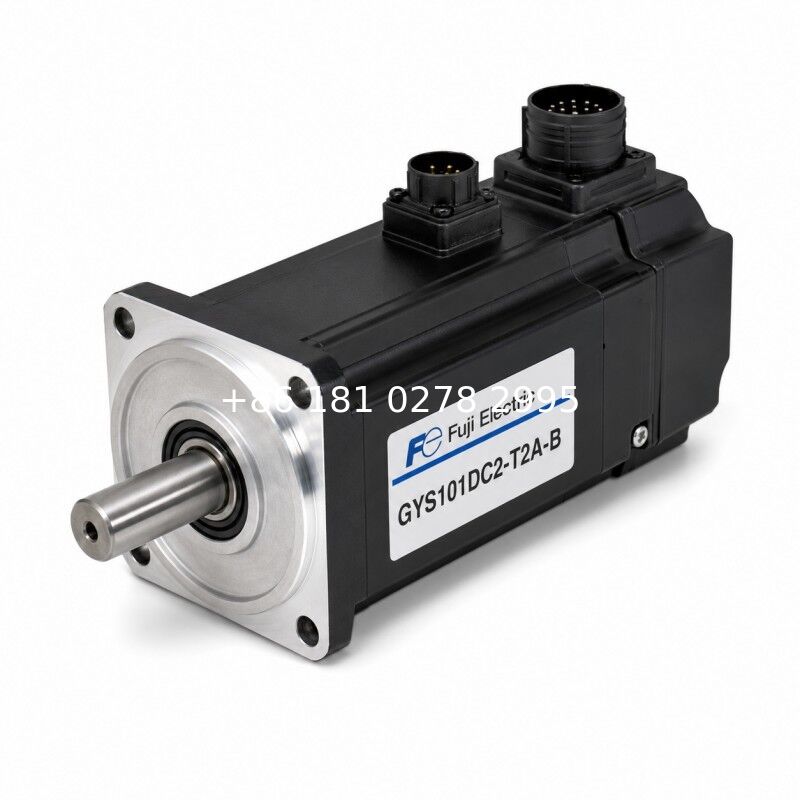

The GYS101DC2-T2A-B is a 100 W FALDIC-W GYS Series AC servo motor designed for compact positioning axes requiring fast response and stationary load holding.
Its ultra-low inertia rotor supports rapid acceleration, quick deceleration and frequent direction changes. The integrated 17-bit serial incremental encoder provides precise position and speed feedback to the compatible servo amplifier.
The final B suffix identifies the brake-equipped version. Its 24 V DC electromagnetic holding brake helps retain a stopped vertical or gravity-loaded mechanism after servo torque is removed.
This model combines a keyed shaft, 3000 r/min rated speed and IP67 motor construction for compact industrial motion applications.
Key Features
- 100 W rated output
- Ultra-low inertia GYS construction
- 17-bit incremental encoder
- Integrated 24 V DC holding brake
- 3000 r/min rated speed
- 5000 r/min maximum speed
- Keyed cylindrical shaft
- IP67 motor structure
Typical Applications
- Vertical positioning axes
- Small lifting mechanisms
- Pick-and-place Z axes
- Compact assembly equipment
- Precision feeding systems
Ultra-Low Inertia Motion Design
The GYS motor structure is optimized for dynamic response rather than high continuous load inertia.
Its low-inertia rotor supports:
- Faster acceleration
- Shorter stopping time
- Frequent start-stop cycles
- Rapid direction changes
- Reduced positioning cycle time
This makes the motor suitable for lightweight machine axes with repeated short movements.
17-Bit Incremental Feedback
The integrated 17-bit serial encoder provides feedback for:
- Position control
- Speed regulation
- Direction detection
- Servo-loop tuning
- Repetitive indexing
It is an incremental encoder and should not be described as an absolute-position motor.
Integrated Holding Brake
The electromagnetic brake is the principal difference between GYS101DC2-T2A-B and GYS101DC2-T2A.
Brake Rated Voltage
24 V DC ±10%
Static Friction Torque
Approximately 0.34 N·m
The brake is intended to hold a stationary shaft after motion has stopped.
It should not be used as the normal method for repeatedly stopping a rotating motor.
Speed and Torque Performance
Rated Output
100 W
Rated Speed
3000 r/min
Maximum Speed
5000 r/min
Rated Torque
0.318 N·m
Maximum Torque
0.955 N·m
Maximum torque is intended for temporary acceleration and deceleration rather than continuous operation.
Keyed Shaft Configuration
The T2A configuration uses a cylindrical shaft with a key.
This shaft type is suitable for:
- Keyed flexible couplings
- Timing-pulley connections
- Compact gear mechanisms
- Positive torque transmission
The coupling bore, key dimensions and shaft alignment must be checked before installation.
IP67 Motor Construction
The motor uses a totally enclosed, self-cooled IP67 construction, excluding the shaft penetration and connector areas.
The installation must still protect:
- Shaft sealing areas
- Power connectors
- Encoder connectors
- Cable entry points
The motor should not be exposed to conditions exceeding the documented environmental limits.
GYS101DC2-T2A-B vs GYS101DC2-T2A
GYS101DC2-T2A-B
100 W
17-bit incremental encoder
Keyed shaft
With holding brake
Approximately 0.7 kg
GYS101DC2-T2A
100 W
17-bit incremental encoder
Keyed shaft
Without holding brake
Approximately 0.55 kg
The integrated brake is the primary difference.
GYS101DC2-T2A-B vs GYS101DC1-CB-B
GYS101DC2-T2A-B
FALDIC-W generation
17-bit incremental encoder
Keyed shaft
IP67 construction
GYS101DC1-CB-B
Earlier servo-system configuration
16-bit incremental encoder
Keyless shaft
Different amplifier and cable compatibility
They should not be substituted based only on power and brake availability.
GYS101DC2-T2A-B vs GYS201DC2-T2A-B
GYS101DC2-T2A-B
100 W
0.318 N·m rated torque
For lighter compact axes
GYS201DC2-T2A-B
200 W
0.637 N·m rated torque
For higher load and acceleration requirements
Motor selection must consider torque, inertia and mechanical dimensions.
Brake Control Notes
A suitable control sequence should:
- Support the load before releasing the brake
- Establish servo torque before brake release
- Stop motor rotation before brake engagement
- Apply the brake before removing servo torque
- Avoid repeated dynamic braking
Incorrect timing may cause load movement or premature brake wear.
Compatibility Checks
Before replacement, verify:
- Full motor reference
- Compatible servo amplifier
- 200 V system configuration
- 17-bit encoder cable
- Motor power cable
- Brake wiring
- Shaft and key dimensions
- Flange dimensions
- Load inertia
- Required holding torque
Matching only the 100 W rating is not sufficient.
FAQ
Q1: What is the rated output of GYS101DC2-T2A-B?
A1: Its rated output is 100 W.
Q2: Does this model include a brake?
A2: Yes. The final B suffix identifies the brake-equipped version.
Q3: What encoder does it use?
A3: It uses a 17-bit serial incremental encoder.
Q4: What is the rated speed?
A4: The rated speed is 3000 r/min, and the maximum speed is 5000 r/min.
Q5: What is the brake voltage?
A5: The holding brake is rated for 24 V DC ±10%.
Q6: What is the rated torque?
A6: The rated torque is 0.318 N·m, with a maximum torque of 0.955 N·m.
Q7: What is the difference from GYS101DC2-T2A?
A7: GYS101DC2-T2A-B includes a holding brake, while GYS101DC2-T2A does not.
Q8: Can the brake stop the motor during normal operation?
A8: No. It is intended primarily to hold the stationary shaft after the motor has stopped.