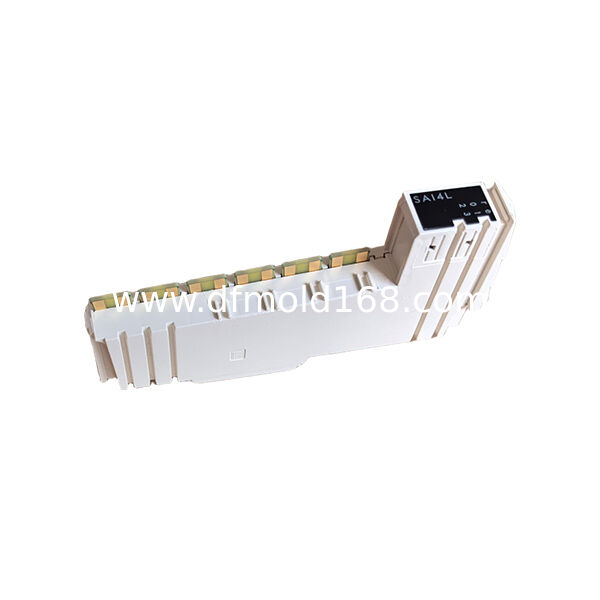
The TM5SDI6D is a Modicon TM5 digital input module designed to receive six 24 V DC sink-type field signals.
It connects sensors, switches and machine-status contacts to a TM5 distributed I/O station and transfers their input states to the controller through the internal TM5 system bus.
The module is particularly suited to machine sections that require a small number of individually monitored inputs rather than a high-density 12-channel or 16-channel input slice.
Its main technical distinction is the combination of six input channels, a fast hardware input filter of no more than 100 microseconds and a configurable software filter from 0 to 25 milliseconds.
This allows the input response to be adapted for either fast machine events or slower signals affected by contact bounce or electrical noise.
The TM5SDI6D supports one-wire and two-wire input connections. Three-wire electronic sensors can also be integrated when the correct external common-distribution arrangement is provided.
The electronic module requires a compatible TM5 bus base and removable terminal block. It is not a complete standalone I/O assembly when supplied without those components.
Key Features
- Six 24 V DC digital inputs
- Sink input logic
- IEC 61131 Type 1 characteristics
- One-wire or two-wire connection
- Fast hardware filtering
- Adjustable software input filtering
- Individual status LED for each input
- Compact low-channel-count I/O slice
- Compatible with modular TM5 stations
Typical Applications
- Proximity-sensor monitoring
- Limit-switch detection
- Push-button inputs
- Machine-status contacts
- Packaging equipment
Six-Channel Input Configuration
The TM5SDI6D provides six independent digital input channels.
This lower channel count is useful when:
- Only a few field signals are required
- Inputs are distributed across separate machine stations
- Cabinet width must be controlled
- Signal grouping needs to remain simple
- Future maintenance requires clear channel identification
For larger input groups, higher-density TM5 digital input modules may be more suitable.
24 V DC Sink Inputs
The module uses sink input logic with a rated voltage of 24 V DC.
The supported supply and input range is:
Minimum
20.4 V DC
Maximum
28.8 V DC
The connected field-device signal type must match the module input logic and wiring arrangement.
IEC 61131 Type 1 Characteristics
The digital inputs follow IEC 61131 Type 1 characteristics.
This makes the module suitable for standard industrial switching devices such as:
- Mechanical contacts
- Relay contacts
- Proximity sensors
- Photoelectric sensors
- Selector switches
- Push buttons
Sensor leakage current and output-state voltage must still be checked before connection.
Input Voltage Thresholds
Official input data specifies:
OFF State
5 V DC Maximum
ON State
15 V DC Minimum
Signals between the guaranteed OFF and ON thresholds should be avoided because the detected state may not be reliable.
Rated Input Current
Each input draws approximately 3.75 mA at 24 V DC.
The input impedance is approximately 6.4 kOhm.
These values are relevant when checking:
- Sensor output compatibility
- Contact loading
- Leakage-current effects
- Cable voltage drop
- Parallel signal arrangements
Fast Hardware Input Filter
The TM5SDI6D provides a hardware filter of no more than 100 microseconds.
This enables detection of relatively fast digital events while suppressing very short disturbances.
Typical uses include:
- Fast proximity-sensor signals
- Product-detection pulses
- Encoder-reference switches
- Indexing confirmation
- Short machine-status transitions
The hardware filter is fixed and should not be confused with the configurable software filter.
Configurable Software Filter
The software filter can be adjusted from 0 to 25 ms in 0.2 ms increments.
Default Value
1 ms
A shorter software filter provides faster response.
A longer software filter can help suppress:
- Mechanical contact bounce
- Electrical interference
- Short unwanted transitions
- Unstable field signals
The filter value should be selected according to the actual signal speed and machine-cycle requirements.
One-Wire and Two-Wire Connections
The module supports one-wire or two-wire field-device connections.
Two-wire sensors can be connected directly according to the approved wiring diagram.
Typical two-wire devices include:
- Two-wire proximity sensors
- Two-wire photoelectric sensors
- Mechanical switching contacts
- Relay contacts
The sensor leakage current must remain compatible with the module’s OFF-state input limits.
Three-Wire Sensor Integration
Three-wire electronic sensors may require an additional common distribution module.
A compatible distribution arrangement can provide the required 0 V or 24 V common connections close to the TM5SDI6D.
This approach supports:
- Cleaner station wiring
- Fewer external terminal blocks
- Shorter sensor conductors
- Easier maintenance
- Organized field-power distribution
The distribution module is separate from the TM5SDI6D.
Channel Isolation
The six input channels are not electrically isolated from one another.
The module provides isolation between the input-side electronics and the internal bus according to the system design.
This means:
- Inputs share the same field-power reference arrangement
- Channels are not individually galvanically isolated
- Separate potential groups require additional system planning
- Grounding and common wiring must be correctly designed
The module should not be advertised as having six independently isolated inputs.
Input Status LEDs
The module has one status LED for each input channel.
LEDs 0 to 5 indicate whether the corresponding input is active.
These indicators support:
- Sensor commissioning
- Wiring checks
- Maintenance troubleshooting
- Signal-state verification
- Rapid identification of failed devices
The input LED only confirms the electrical state detected by the module. It does not confirm the controller program response.
Module Status LEDs
The module also includes run and error indicators.
Run LED
Shows reset, preoperational or normal operating status.
Error LED
Can indicate invalid firmware or an abnormal module condition.
These indicators help distinguish a channel-level wiring problem from a system-level module problem.
Power Consumption
The TM5SDI6D draws current from both the TM5 bus and the 24 V DC I/O power segment.
TM5 Bus Current
30 mA at 5 V DC
24 V DC I/O Segment Current
37 mA with all inputs active
Maximum Power Dissipation
1.03 W
These values must be included in the complete TM5 station power-budget calculation.
Required Bus Base
The electronic module requires a compatible bus base.
TM5ACBM11
Standard white bus base.
TM5ACBM15
Bus base with address-setting capability.
The correct base depends on the TM5 station architecture.
Compatible Terminal Blocks
The module can be used with:
TM5ACTB06
6-pin terminal block.
TM5ACTB12
12-pin terminal block.
The selected terminal block must match the intended wiring method and station layout.
TM5SDI6D vs Higher-Density Input Modules
TM5SDI6D
Six inputs
Suitable for small distributed signal groups
Simple channel identification
Supports fast configurable filtering
Higher-Density TM5 Input Module
More input channels in one slice
Better suited to centralized sensor groups
May reduce the number of modules required
The correct choice depends on channel count, wiring layout and maintenance requirements.
TM5SDI6D vs Digital Output Module
TM5SDI6D
Reads external digital signals.
Does not switch loads.
TM5 Digital Output Module
Controls external devices such as relays, lamps or solenoid valves.
These modules are not interchangeable.
TM5SDI6D vs Safety Input Module
TM5SDI6D
Standard Type 1 digital input module.
Used for normal machine-control signals.
Safety Input Module
Designed for validated safety-related input processing.
Requires compatible safety hardware and software.
TM5SDI6D must not be described as a fail-safe input module.
Not a Communication Module
The TM5SDI6D does not provide:
- Ethernet
- PROFINET
- CANopen
- Sercos
- Modbus network coupling
- Independent controller processing
Communication is handled by the TM5 controller or bus interface installed in the station.
Replacement Identification
Correct Model Number
TM5SDI6D
Product Type
Six-Channel Digital Input Module
Input Logic
Sink
Rated Voltage
24 V DC
Wiring Type
One-Wire or Two-Wire
Required Bus Base
TM5ACBM11 or TM5ACBM15
Before replacement, confirm:
- Exact module number
- Input-channel count
- Sink input logic
- Sensor wiring type
- Input filter settings
- Bus-base reference
- Terminal-block reference
- Station power budget
- Controller hardware configuration
- Existing channel assignments
Do not select a replacement only according to the TM5 housing appearance.
Installation Guidelines
Disconnect the TM5 station and field power.
Verify that the connected sensors are de-energized.
Record the existing channel assignments.
Label all field wires.
Confirm the bus-base reference.
Confirm the terminal-block reference.
Install the bus base on the DIN rail.
Fit the TM5SDI6D electronic module.
Install the terminal block.
Connect each input according to the approved wiring diagram.
Check polarity and common connections.
Restore station power.
Verify the run and error indicators.
Test inputs 0 through 5 individually.
Confirm the software filter settings.
Compare field-device states with controller input values.
Return the machine to service only after functional verification.
Installation should be completed by qualified automation personnel.
FAQ
Q1: What is TM5SDI6D?
A1: It is a Modicon TM5 digital input module with six 24 V DC sink inputs.
Q2: How many input channels does it provide?
A2: It provides six digital input channels.
Q3: What type of input logic does it use?
A3: It uses sink input logic with IEC 61131 Type 1 characteristics.
Q4: Does it support two-wire sensors?
A4: Yes. The module supports one-wire and two-wire input connections.
Q5: Can three-wire sensors be connected?
A5: Yes, but an appropriate common-distribution arrangement may be required.
Q6: What is the hardware input-filter time?
A6: The hardware filter is no more than 100 microseconds.
Q7: Can the software filter be adjusted?
A7: Yes. It can be configured from 0 to 25 ms in 0.2 ms increments.
Q8: Are the six channels individually isolated?
A8: No. The channels are not isolated from one another.
Q9: Which bus bases are compatible?
A9: It uses TM5ACBM11 or TM5ACBM15.
Q10: What distinguishes TM5SDI6D from other TM5 input modules?
A10: Its defining combination is six 24 V DC sink inputs, low channel density, two-wire sensor support and configurable high-speed input filtering.

 Your message must be between 20-3,000 characters!