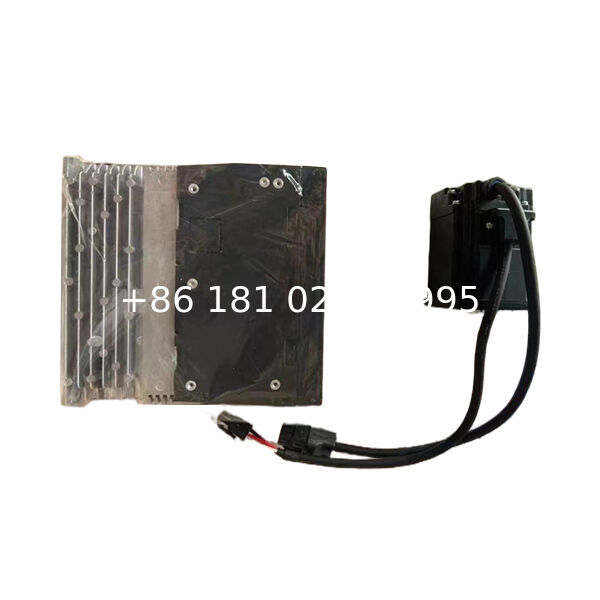
The RYT401F7-VC2 and GYB401D7-RC2 combination is a matched 400 W ALPHA7 servo system designed for industrial machines requiring EtherCAT communication and stable control of medium-inertia mechanical loads.
The RYT401F7-VC2 servo amplifier supports position, speed and torque control through an EtherCAT network. It is matched to the 400 W GYB401D7-RC2 AC servo motor, reducing uncertainty when selecting the amplifier capacity and motor output separately.
Unlike ultra-low-inertia GYS motors intended primarily for very light and rapidly changing loads, the GYB401D7-RC2 uses a middle-inertia rotor. This provides a more balanced mechanical response for belt drives, ball screws, rollers and other mechanisms with moderate load inertia.
The motor includes a 20-bit incremental encoder, a straight shaft without a key and no electromagnetic holding brake.
Key Features
- Matched 400 W amplifier and motor set
- EtherCAT communication interface
- Position, speed and torque control
- Middle-inertia GYB motor design
- 20-bit incremental encoder
- 3000 r/min rated motor speed
- 1.27 N·m rated motor torque
- Keyless shaft and non-brake configuration
Typical Applications
- Fiber laser motion axes
- Packaging machinery
- Ball-screw positioning systems
- Conveyor and roller control
- Automated assembly equipment
EtherCAT Servo Amplifier
The RYT401F7-VC2 uses EtherCAT as its command and communication interface.
EtherCAT integration supports:
- Network-based motion commands
- Multi-axis synchronization
- Position control
- Speed control
- Torque control
- Parameter setting and monitoring
This makes the amplifier different from the RYT401F7-VV2 general-purpose interface version and the RYT401F7-VS2 SX-bus version.
Matched 400W System
The amplifier and motor share the same 400 W capacity class.
Servo Amplifier
RYT401F7-VC2
Servo Motor
GYB401D7-RC2
Rated System Output
400 W
Using a capacity-matched amplifier and motor helps simplify:
- Servo system selection
- Parameter configuration
- Current and torque matching
- Motor feedback compatibility
- Replacement planning
Cables, connectors, controller compatibility and software settings must still be verified separately.
Middle-Inertia Motor Design
The GYB401D7-RC2 uses a middle-inertia rotor.
Compared with an ultra-low-inertia motor, this construction is better suited to mechanisms such as:
- Ball screws
- Timing belts
- Feed rollers
- Compact gear reducers
- Moderate-inertia rotary loads
The middle-inertia design provides a balanced response where mechanical stability is as important as acceleration speed.
20-Bit Incremental Encoder
The motor uses a 20-bit incremental encoder for position and speed feedback.
The encoder supports:
- Precise repetitive positioning
- Stable speed regulation
- Low-speed movement
- Servo-loop tuning
- Motion synchronization
Because it is an incremental feedback configuration, the machine normally requires an origin-return or homing procedure after startup.
Motor Speed and Torque
Rated Output
400 W
Rated Speed
3000 r/min
Maximum Speed
5000 r/min
Rated Torque
1.27 N·m
Maximum Torque
Approximately 3.82 N·m
Maximum torque is intended for temporary acceleration and deceleration and should not be treated as continuous operating torque.
Keyless Shaft Configuration
The RC2 configuration uses a straight shaft without a key.
This shaft is suitable for:
- Clamp-type couplings
- Flexible precision couplings
- Low-backlash mechanical connections
- Direct-coupled ball screws
The coupling bore, clamping force and shaft alignment must be checked during installation.
Non-Brake Motor Version
GYB401D7-RC2 does not include an electromagnetic holding brake.
It is primarily suitable for:
- Horizontal axes
- Non-suspended loads
- Rotary mechanisms
- Systems with an external holding device
For a vertical or gravity-loaded axis, a brake-equipped motor such as GYB401D7-RC2-B should be evaluated.
RYT401F7-VC2 vs RYT401F7-VV2
RYT401F7-VC2
EtherCAT interface
Position, speed and torque control
Networked multi-axis systems
RYT401F7-VV2
General-purpose command interface
Pulse, analog and positioning functions
Conventional controller connections
The two amplifiers use different command interfaces and should not be substituted without checking the machine controller.
RYT401F7-VC2 vs RYT401F7-VS2
RYT401F7-VC2
EtherCAT communication
RYT401F7-VS2
SX-bus communication
Both belong to the 400 W ALPHA7 amplifier range, but their network interfaces are different.
GYB401D7-RC2 vs GYB401D7-RC2-B
GYB401D7-RC2
400 W
20-bit incremental encoder
Keyless shaft
No holding brake
GYB401D7-RC2-B
400 W
20-bit incremental encoder
Keyless shaft
Integrated holding brake
The brake-equipped version is more suitable for stationary load holding on vertical axes.
GYB401D7-RC2 vs GYS401D7 Series
GYB401D7-RC2
Middle-inertia motor
Balanced response for moderate mechanical inertia
Suitable for ball screws, belts and rollers
GYS401D7 Series
Ultra-low-inertia motor
Faster response for lightweight mechanisms
Suitable for rapid indexing and frequent direction changes
Motor selection should be based on load inertia, acceleration time and mechanical transmission structure.
System Compatibility Checks
Before purchasing or installing the set, confirm:
- Amplifier nameplate model
- EtherCAT controller compatibility
- Motor and amplifier capacity
- Encoder cable reference
- Motor power cable reference
- EtherCAT cable specification
- Connector configuration
- Motor shaft dimensions
- Required holding brake
- Regenerative resistor requirements
- Firmware and parameter settings
The amplifier and motor may be capacity-matched, but cables and optional accessories are not automatically included unless specifically stated.
Installation Notes
- Verify whether the amplifier nameplate reads VC2 or VCS2
- Disconnect all main and control power
- Confirm 200 to 240 V system compatibility
- Connect protective grounding correctly
- Use shielded EtherCAT and encoder cables
- Install a suitable keyless coupling
- Align the motor and load shafts
- Configure the EtherCAT device address
- Set the correct motor parameters
- Test rotation direction at low speed
- Complete homing before production
FAQ
Q1: What is the rated output of this servo set?
A1: The amplifier and motor are in the 400 W capacity class.
Q2: What communication interface does the amplifier use?
A2: The standard RYT401F7-VC2 amplifier uses EtherCAT.
Q3: What motor is included?
A3: The motor model is GYB401D7-RC2, a 400 W middle-inertia AC servo motor.
Q4: What encoder does the motor use?
A4: It uses a 20-bit incremental encoder.
Q5: Does the motor include a brake?
A5: No. GYB401D7-RC2 is the non-brake version.
Q6: What is the motor shaft type?
A6: It uses a straight shaft without a key.
Q7: What distinguishes this set from a GYS motor system?
A7: The GYB motor has middle inertia for more balanced control of moderate-inertia loads, while GYS motors use an ultra-low-inertia design.
Q8: Is RYT401F7-VCS2 the official standard model?
A8: The standard Fuji Electric ALPHA7 EtherCAT reference is RYT401F7-VC2. The physical nameplate should be checked before finalizing the product reference.

 Your message must be between 20-3,000 characters!